

When you get down to it, the branded house vs house of brands debate comes down to a single question: do you want to market everything under one powerful parent brand, or manage a portfolio of distinct, separate brands?
A branded house, like Google, centralizes its reputation. A house of brands, like Procter & Gamble, diversifies it. For B2B leaders in competitive markets like Canada and the United States, your choice here isn't just a branding exercise—it dictates how you build equity, allocate your marketing budget, and ultimately, scale the business. This strategic decision can be the difference between market dominance and obscurity, with a 2022 Nielsen report showing that brands with a clear, consistent architecture grew 1.5x faster than their less-focused competitors in North America.
Choosing Your B2B Brand Architecture

Picking the right brand architecture is a foundational C-level decision. It directly impacts your operational efficiency, customer acquisition costs, and even investor confidence. For SaaS, tech, and industrial firms across Canada and the United States, getting this right is critical for sustainable, long-term growth.
This is where implementing top brand positioning strategies becomes essential, as your architecture frames how customers, employees, and the market perceive your entire portfolio.
Core Strategic Models Defined
The branded house model is all about centralization. It creates a powerful "halo effect" where trust in the master brand automatically extends to all its products and services. A fantastic success story is Google. Their master brand is so dominant that products like Google Maps, Google Drive, and Google Ads launched with immediate credibility, saving millions in marketing spend. This unified approach simplifies marketing and builds a massive, recognizable presence.
On the other hand, a house of brands intentionally isolates each brand. This allows a company to target wildly different market segments without diluting the parent company's identity. It’s also a fantastic way to mitigate risk; if one brand stumbles, the others remain untouched. A prime example is General Motors, which successfully markets distinct brands like Chevrolet, Cadillac, and GMC to entirely different consumer psychographics in the US and Canada.
A recent study found that 59% of consumers prefer to buy from brands they know and trust. This underscores the need to pick an architecture that builds that deep, lasting connection, whether through a single unified voice or a family of distinct brands.
Here's a quick look at the key differences:
| Feature | Branded House (e.g., Google) | House of Brands (e.g., P&G) |
|---|---|---|
| Brand Identity | A single, unified master brand across all products. | Multiple, distinct brands with unique identities. |
| Marketing Focus | Promotes the master brand's value and reputation. | Builds individual brand stories for niche markets. |
| Risk Profile | High risk; a negative event can damage the entire brand. | Low risk; brand-specific issues are contained. |
| Cost Efficiency | More efficient due to shared marketing resources. | Less efficient due to separate marketing budgets. |
Ultimately, your choice hinges on your long-term goals. Are you trying to build a single, towering reputation? Or do you want to dominate multiple niche markets with highly tailored solutions? Answering that question is the first real step toward a brand architecture that drives measurable growth.
Building the right brand foundation is a C-level decision. If you're ready to define a brand architecture that aligns with your revenue goals, Contact us today for a strategic consultation.
The Branded House: A Deep Dive For B2B Scale-Ups
For a B2B scale-up in Canada or the United States, the branded house model is often the straightest line to building a formidable market presence. This architecture stacks all your products and services under a single, monolithic master brand. Every new launch, marketing campaign, and sales conversation reinforces one name, building equity with ruthless efficiency.
Instead of splitting your resources to build awareness for multiple individual brands, every marketing dollar works to strengthen one primary identity. This unified approach is a godsend for resource-constrained startups that need to squeeze the maximum impact out of every dollar spent on growth.
The Power of the Halo Effect
The real magic of the branded house is the halo effect. When customers trust your master brand, that trust automatically spills over to any new product or service you introduce. It’s a powerful shortcut to credibility.
Think about FedEx. The master brand is practically synonymous with reliability and speed. When they launch FedEx Freight or FedEx Office, customers don't need a lengthy sales pitch; they immediately associate these new services with the core promises of the parent brand. This makes market penetration faster and a whole lot cheaper. A 2023 study by Prophet found that strong master brands can reduce customer acquisition costs by up to 50%.
A strong master brand simplifies the buying journey. By distilling many brand promises down to one, you allow sub-brands to draft off the parent brand's reputation, accelerating adoption and reducing customer acquisition costs.
For a B2B scale-up, this means your reputation becomes your most valuable asset. The positive experience a customer has with one of your products directly buffs up their perception of your entire suite of offerings, making cross-selling and upselling feel far more natural. Learn more about the nuances of this approach in our guide on branding in professional services.
Marketing Efficiency and SEO Dominance
A branded house model drastically simplifies marketing and SEO. With one website, one set of social media profiles, and one unified content strategy, you can focus your efforts and budget with surgical precision.
This consolidation creates a powerful flywheel for SEO. Every blog post, every backlink, and every media mention contributes to the authority of a single domain. Over time, this makes it much easier to rank for competitive keywords related to your industry, driving a rising tide of organic traffic that lifts all your product lines. This is a key differentiator when comparing a branded house vs house of brands, as the latter has to build SEO authority for multiple domains from scratch.
This efficiency isn't just theory. In Canada's competitive B2B landscape, particularly among the tech and SaaS startups in Kitchener-Waterloo, a branded house has proven far more effective for building reputation. A Hinge Marketing study found that while 57% of buyers rated sellers highly for reputation, only 23% felt they had strong visibility—a gap a single master brand is perfectly designed to close. Furthermore, a 2023 Statistics Canada report showed that firms using one cohesive brand spent 34% less on advertising per revenue dollar compared to those managing multiple sub-brands.
Sure, there's a risk that one negative event could tarnish the entire brand. But for B2B scale-ups aiming for aggressive growth, the benefits of focused investment, simplified messaging, and rapid equity-building often outweigh the drawbacks.
Ready to build a powerful, unified brand that drives measurable results? Contact us today for a strategic consultation to discuss how a branded house strategy can accelerate your growth.
The House Of Brands: Unpacking The Multi-Brand Strategy
Where a branded house gathers everything under one roof, the house of brands architecture is all about strategic separation. Think of a parent company that owns a portfolio of distinct, sometimes even competing, brands. Each brand operates with its own identity, audience, and market position, while the parent company often stays completely out of the spotlight.
This approach is rooted in diversification and sharp-shooter targeting. Instead of trying to make one brand appeal to everyone—and risk speaking to no one—a house of brands lets each sub-brand craft a unique voice and value proposition for a very specific buyer. This is a massive factor in the branded house vs house of brands debate.
Dominating Niche Markets
The real power of a house of brands lies in its ability to capture multiple niche markets without diluting its message. Each brand can forge a deep, authentic connection with its target audience, speaking their language and solving their specific problems.
A prime B2B example is Danaher, a global science and technology powerhouse based in the United States. While the Danaher name is well-known in financial circles, its customers engage with highly specialized brands like Beckman Coulter in life sciences or Leica Microsystems in microscopy. Each is a leader in its own right, building a reputation on its own merits. This lets Danaher dominate several high-value verticals at once, a strategy that helped it grow revenue to over $29 billion in 2023.
By isolating brands, a parent company can mitigate risk. A setback or controversy affecting one brand won't tarnish the reputation of others in the portfolio, protecting the parent company's overall asset value.
This strategy is also a lifesaver during mergers and acquisitions. When a company buys a business with powerful, pre-existing brand equity, forcing it under the parent's banner can obliterate the very value it just paid for. A house of brands model allows the acquired brand to keep thriving, retaining its loyal customer base while tapping into the parent's resources. Our guide on managing brands with sub-brands offers a closer look at these complex dynamics.
The Cost of Independence
But this flexibility doesn't come cheap. Managing a portfolio of individual brands is far more resource-intensive than maintaining a single master brand. Each brand demands its own dedicated budget for marketing, legal, and operational support.
Just consider the overhead involved:
- Separate Marketing Teams: Every brand needs its own campaigns, content strategy, and social media presence.
- Multiple Legal Entities: This often means separate trademarks, copyrights, and legal frameworks.
- Operational Complexity: Juggling distinct supply chains, sales channels, and customer support systems can get incredibly complicated.
The financial and operational burden is substantial. Building brand awareness from scratch for each new entity is a long and expensive grind, a world away from the instant credibility a branded house offers. Customer loyalty is a hard-won asset; a 2024 report by Bond found that 79% of North American consumers are more likely to stick with a brand that understands and cares about them, highlighting the investment needed for each brand in a portfolio.
For B2B companies in Canada and the United States, this model really only makes sense for well-capitalized corporations with a long-term vision for market segmentation or an aggressive acquisition strategy. It offers unmatched market reach and risk insulation but demands a level of investment that's simply out of reach for most startups and scale-ups.
If you’re navigating the complexities of brand architecture and need expert guidance to choose the right path for your business, Contact us today for a strategic consultation.
Head-to-Head: A Strategic B2B Comparison
Choosing between a branded house and a house of brands isn't just a cosmetic decision. It's a strategic fork in the road that directly shapes your company's performance. For B2B leaders in Canada and the United States, this choice dictates how efficiently you can market, how effectively your sales team can operate, and how much financial overhead you'll carry.
Let's move beyond generic pros and cons. We'll compare these two architectures across five critical business functions, using scenarios that hit close to home for North American SaaS and industrial firms. This framework will give you the clarity needed to weigh the real-world implications of each model.
Marketing and SEO Efficiency
Under a branded house model, your marketing efforts are consolidated and amplified. Every blog post, every backlink earned, and every dollar spent on advertising reinforces a single, powerful domain. This creates an SEO juggernaut where the authority of the master brand lifts all product and service pages, making it easier to rank for competitive keywords. A 2023 report confirmed that unified brands spent 34% less on advertising per revenue dollar than their multi-brand counterparts.
Conversely, a house of brands demands separate, resource-intensive marketing for each entity. Each brand must build its own domain authority, social media following, and content strategy from scratch. While this allows for hyper-targeted niche campaigns that speak directly to a specific buyer persona, it comes at a significant cost in both time and budget, with no shared SEO equity between brands.
Sales Cycle Impact
The branded house dramatically streamlines the B2B sales cycle. The inherent trust and reputation of the master brand—what we call the "halo effect"—pre-sells prospects and shortens the path from awareness to consideration. Your sales team can walk into a meeting and leverage the parent brand's credibility to open doors and overcome objections, creating a smoother, more efficient process. A Gartner study revealed that B2B buyers are 5x more likely to engage with a sales rep from a well-known brand.
A house of brands creates distinct sales funnels for each brand. This can be a huge advantage when selling to wildly different markets; the sales narrative for an industrial component brand won't get diluted by a SaaS product's messaging. However, it also means sales teams can't easily lean on the reputation of a sister brand, forcing them to build trust independently for each product line.
The core difference lies in leverage. A branded house leverages existing equity to accelerate new sales. A house of brands builds equity from scratch for each new market, offering deeper specialization at the cost of speed.
Customer Cross-Selling Potential
For a branded house, the cross-selling potential is immense. Since all products and services live under one trusted name, introducing a customer to a new offering feels like a natural extension of the relationship. A client who trusts your core SaaS platform is far more likely to adopt an add-on analytics tool from the same brand. It just makes sense.
This gets more complicated in a house of brands. While cross-selling is still possible at a corporate level, it requires a much more deliberate effort to connect the dots for the customer, as there's no shared brand identity to bridge the gap. Success here relies more on account management excellence than on the brand architecture itself.
Employer Branding and Talent Acquisition
A unified branded house often builds a stronger, more cohesive employer brand. It simplifies recruiting by promoting one mission and one set of values, making it easier to attract talent aligned with the company's core identity. This is especially crucial in competitive tech hubs across North America, from Kitchener–Waterloo to Silicon Valley. According to LinkedIn, companies with a strong employer brand see a 43% decrease in cost per hire.
A house of brands, on the other hand, can attract highly specialized talent for each of its distinct businesses. An expert marketer for a high-fashion brand might not be the right fit for an industrial manufacturing brand, and this model allows for perfectly tailored recruitment. The trade-off is a fragmented employer identity that requires more effort to manage and communicate a cohesive corporate culture.
Financial and Operational Overhead
Finally, the financial implications are stark. A branded house is fundamentally more cost-effective. Shared resources—from marketing budgets and legal teams to a single C-suite—reduce operational overhead significantly. This financial efficiency is a major reason why so many B2B startups and scale-ups favour this model.
The house of brands, by its very nature, duplicates roles and budgets across its portfolio. Each brand needs its own leadership, marketing spend, and operational support, leading to much higher overhead. While this structure offers fantastic risk mitigation by isolating brands from one another, it demands a level of capitalization that's often beyond the reach of early-stage companies.
Branded House vs. House of Brands Strategic B2B Comparison
| Business Driver | Branded House Approach | House of Brands Approach |
|---|---|---|
| Marketing & SEO | Centralized efforts build a single, powerful domain authority. Lower cost per acquisition due to shared equity. | Decentralized efforts require building each brand's authority from scratch. Higher costs but allows for hyper-niche targeting. |
| Sales Cycle | The master brand's reputation (halo effect) shortens sales cycles and builds trust faster. | Each brand builds trust independently. Can be effective for disparate markets but lacks shared credibility. |
| Cross-Selling | Seamless. A shared brand identity makes it natural to introduce customers to new offerings. | Complex. Requires deliberate effort to connect brands in the customer's mind. Relies on strong account management. |
| Talent Acquisition | Attracts talent to a single, strong employer brand and unified company culture. Simpler to manage. | Attracts specialized talent for niche brands. Can result in a fragmented employer identity. |
| Financial Overhead | Lower overhead due to shared resources (marketing, legal, leadership). More capital efficient. | Higher overhead due to duplicated roles and budgets. Offers risk isolation but is more capital intensive. |
| Risk Management | A crisis impacting one product can damage the entire master brand. "All eggs in one basket." | A crisis is contained to a single brand, protecting the parent company and sister brands. |
| Market Expansion | New products launch with immediate credibility but must align with the master brand's identity. | Can enter completely new, unrelated markets without diluting other brands. Offers maximum flexibility. |
Ultimately, there's no single "right" answer. The best brand architecture depends entirely on your long-term vision, your target markets, and your financial reality. A branded house prioritizes efficiency and leverage, while a house of brands prioritizes specialization and risk mitigation.
Deciding between these models is a critical step. If you need an experienced guide to help you navigate this decision and build a brand that fuels your growth, Contact us today for a strategic consultation.
Making The Right Choice: A B2B Decision Framework
Deciding between a branded house and a house of brands isn't just a marketing exercise. It’s a foundational business decision that will echo through your growth plans, budget, and operational focus for years to come. To get this right, you need to move beyond theory and ask a series of tough, strategic questions that tie your brand architecture directly to your financial reality and revenue goals.
To cut through the complexity of B2B brand architecture, we've built a decision framework that incorporates proven decision making frameworks to bring clarity to your choices. By walking through these critical points, especially with the Canadian and US B2B markets in mind, you can land on a data-backed decision that sets you up for sustainable success.
This decision tree gives you a quick visual guide to the core paths, based on your business strategy and market focus.
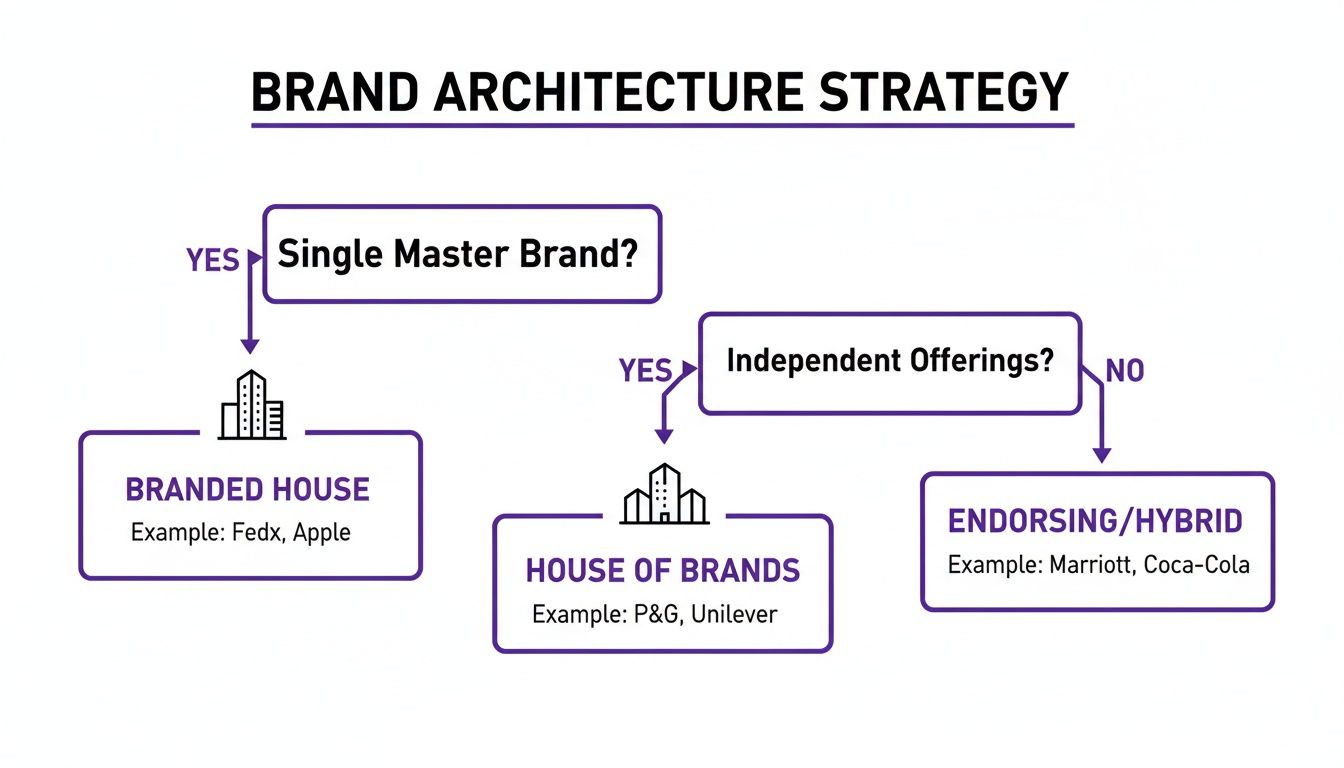
The key takeaway? A strategy built on unified markets and organic growth almost always points toward a branded house. A strategy targeting diverse markets through acquisition leans heavily toward a house of brands.
Your Long-Term Growth Strategy
First, pull out your five-to-ten-year roadmap. Is your growth plan mostly about organic expansion, where you'll be developing and launching new products internally? If so, a branded house is almost always the most efficient route. It lets you funnel all your existing brand equity into new offerings, giving them an immediate shot of credibility while slashing launch costs and speeding up market adoption.
But if your strategy is driven by acquisitions, a house of brands offers critical flexibility. It allows you to buy companies with strong, established brand equity without having to gut that value by forcing them under your corporate banner. You get to keep the loyalty and recognition the acquired brand already worked so hard to build. For example, when Mars acquired the popular Canadian pet food brand Champion Petfoods, they kept the Orijen and Acana brands separate, preserving billions in established brand equity.
Market and Buyer Persona Diversity
Next, take a hard look at who you sell to. Are your products aimed at the same core buyer persona? Or are you chasing completely distinct customer segments with wildly different needs, pain points, and buying habits?
When your buyer personas are closely related, a branded house creates a cohesive and seamless customer experience. But when they are worlds apart, forcing them under one brand can dilute your messaging and confuse everyone.
For instance, a Canadian tech company trying to sell an enterprise cybersecurity platform and a small business accounting tool under one brand would face an uphill battle. The message that resonates with a CISO is worlds away from what a small business owner needs to hear. A house of brands lets each product tell its own unique, compelling story. You can get a better handle on this by exploring how to write a value proposition that connects with a specific audience.
Operational Complexity and Financial Tolerance
Finally, be brutally honest about your resources. A branded house is operationally simpler and far more cost-effective. You've got one marketing team, one brand budget, and one set of guidelines to follow. For startups and scale-ups in North America where capital efficiency is king, this model is often the default choice.
On the other hand, a house of brands multiplies your complexity. Every single brand needs its own marketing budget, a dedicated team, and operational support, which sends your overhead costs soaring. It’s a model best suited for well-capitalized organizations that have the runway to fund multiple, independent growth engines.
For Canadian B2B startups, a branded house offers a distinct competitive edge. Research from Forrester has shown that master brand strategies are dominant in B2B because they help rally everyone around a single mission. A 2024 report from the Waterloo Economic Development Corporation found that 55% of Ontario SaaS firms struggled with complexity after an acquisition; those who unified their brand reported 37% faster go-to-market times and 29% lower operational costs. With 64% of Canadian scale-ups citing internal silos as a barrier to growth, a branded house can foster a much more cohesive culture.
Making the right choice demands deep strategic alignment. If you need an experienced partner to help build a brand architecture that drives measurable revenue, Contact us today for a strategic consultation.
Build Your Brand Architecture With Expert Guidance
Choosing your brand architecture is a C-level decision, not just a marketing task. The branded house vs. house of brands debate shapes your company’s future, influencing everything from investor perception and operational efficiency to your ability to attract top talent. Get this wrong, and you're looking at wasted marketing spend, a confusing customer journey, and a growth trajectory that’s stalled before it even begins.
It’s a strategic fork in the road where an objective, senior-level perspective is invaluable. Many B2B leaders in Canada and the United States are simply too close to the business to see the long-term architectural implications clearly. The right call demands a delicate balance of market insight, financial forecasting, and a deep understanding of what your brand truly stands for.
Bridge The Gap Between Strategy and Execution
Making the choice is only step one; the real work lies in a successful rollout. A poorly handled transition can alienate existing customers and confuse internal teams, sabotaging the very goals you set out to achieve. A solid architecture needs a documented, structured plan that gets every department—from sales and marketing to product and HR—pulling in the same direction.
This is where a Fractional CMO becomes a critical partner. We step in to provide the C-level marketing leadership needed to navigate these complexities, all without the overhead of a full-time executive hire. Our process is built on collaboration and clarity, turning your brand architecture from a concept on a slide deck into a living strategy that drives real-world results.
A recent report highlighted that companies with strong brand alignment see an average revenue growth of 23% higher than their competitors. This underscores the direct financial impact of getting your brand architecture right from the start.
Our Collaborative Approach
We work as an extension of your leadership team, guiding you through a proven process designed to deliver a brand architecture that directly fuels your business objectives. Our approach is broken down into three clear phases:
- Discover and Define: We go deep on your long-term business goals, market position, buyer personas, and competitive landscape. This phase includes facilitating the tough conversations needed to align your leadership team around a single, unified vision for growth.
- Strategize and Structure: Using what we’ve learned, we help you select the optimal brand architecture—be it a branded house, house of brands, or a hybrid model. From there, we build out a comprehensive implementation roadmap, complete with messaging frameworks, visual identity guidelines, and a clear communication plan.
- Execute and Evaluate: We work alongside your team to roll out the new architecture, ensuring a smooth transition for both internal and external stakeholders. We also establish key performance indicators to measure the impact on brand awareness, lead generation, and ultimately, pipeline revenue.
The decision between a branded house and a house of brands is too important to leave to chance. If you’re a B2B leader in Canada or the US ready to build a brand architecture that drives measurable growth, it’s time to take the next step.
Contact us today for a strategic consultation and let's build your brand for a better tomorrow.
Your Top Questions Answered
When you're weighing a branded house against a house of brands, a few practical questions always come up. Here are the straight answers on hybrid models, the pain of switching, and which approach builds equity the fastest.
Can We Just Use a Hybrid Model?
You absolutely can. In fact, a hybrid model that mixes elements of both architectures is a common and highly practical solution, especially for established B2B firms that grow through acquisition. It offers a ton of flexibility.
Take Salesforce, for instance. The core platform—with its Sales Cloud and Marketing Cloud—is a classic branded house. But when they acquire heavyweights like Slack and Tableau, those brands keep their distinct identities. They operate as endorsed brands, borrowing Salesforce's credibility while still serving their own loyal user bases. This strategy has been a massive success, allowing Salesforce to integrate new technologies without disrupting established brands, contributing to its rise as a $34.8 billion company.
How Hard Is It to Switch from One to the Other?
Let’s be clear: migrating your brand architecture is a major undertaking. It's far more than a simple rebrand. This kind of shift touches everything from your website's SEO and internal culture to how your sales team talks about your products. It requires serious strategic planning and resources.
A successful migration is a phased process that can take months, sometimes years. There's a huge financial incentive to get it right, as companies with strong brand alignment see 23% higher revenue growth on average. You need to get leadership aligned, bring employees on the journey, and prepare your customers for the change to avoid confusion.
Switching from a house of brands to a branded house often means consolidating websites, messaging, and marketing teams into one unified front. Going the other way—from a branded house to a house of brands—involves the costly and operationally complex task of building separate identities and budgets from the ground up.
Which Model Builds Brand Equity Faster?
For B2B startups and scale-ups, the answer is almost always a branded house. It allows you to pour every ounce of marketing effort and every dollar of your budget into a single master brand. Every product launch, every successful case study, every bit of press reinforces one name. This creates a powerful halo effect that gives new offerings instant credibility. A 2023 Interbrand report noted that companies with a strong branded house architecture saw their brand equity grow 18% faster year-over-year than multi-brand conglomerates.
A house of brands, by design, builds equity for individual product brands. That process is slower and far more resource-intensive. While it can create multiple valuable assets over the long haul, it doesn't give you the rapid, focused equity lift that a branded house provides right out of the gate. The choice really boils down to whether you want to build a single, powerful reputation quickly or cultivate a diverse portfolio over time.
Ready to build a brand architecture that drives real growth and lines up with your business goals? As a fractional CMO partner based in Kitchener–Waterloo, B2Better brings the senior-level expertise needed to guide B2B leaders across North America through these critical decisions.