

Most B2B teams have a brand guide.
Almost none have a brand context document.
The first one is a PDF that lives on a Notion page and gets read on a Zoom kickoff call. The second one is what your AI tools are starving for. Same brand, same buyer, same product. Different document. Output quality changes by an order of magnitude.
I have spent the last 18 months rebuilding how B2B brands get documented for AI activation. The teams that do this work first run circles around the teams that buy tools first. The architecture is the leverage. The tools are downstream.
Why this matters now
The 2026 numbers are unflattering.
Roughly half of marketing teams are running AI without persistent brand context, according to recent state-of-AI-content reports. Only 23.3% of companies have AI agents fully integrated into their marketing stack in production, per Aprimo’s analysis of generative AI brand management (April 2026). The rest are running AI in silos that do not share context or maintain voice.
The input side tells the same story. Salesforce’s State of Marketing data reports 51% of companies using generative AI in marketing, with another 22% planning adoption. Teams cite 45% faster campaign development and 30% cost reduction. But output quality varies wildly between companies running the same tools, with similar prompts, on the same models.
The difference is not the AI. The difference is what was fed to it.
Adobe’s 2026 Digital Trends Report frames it this way: leading brands are operationalizing brand context as the input layer for agentic workflows, not as marketing collateral. That is the distinction most teams have not made yet.
This is a Pillar 3 problem (brand architecture) creating a Pillar 1 result (failed AI activation). Architecture before activation. Always.
The framework: a 7-part Brand Context Document
A brand guide is the brand book your designer published in 2024.
A brand context document is something else entirely. It is the operating system the brand runs on. It is what an AI tool, a new agency, a contract writer, or a co-founder backstop can pick up tomorrow and produce work that sounds like you.
Here are the 7 sections every B2B brand context document I build now includes. Skip any of them and the AI will fail predictably in that exact gap.
1. The “what we are” statement (positioning, not category)
Three sentences. Concrete. No category language.
Wrong: “We are a leading B2B SaaS provider of marketing automation.”
Right: “We help B2B SaaS founders under $10M revenue replace fragmented marketing tools with one operating system, charged as a fixed monthly retainer.”
The wrong version gives the AI nothing to work with. Every B2B SaaS provider claims to be leading. The right version names the buyer, the size, the alternative, and the pricing structure. Now the model knows what to write toward and, more importantly, what to filter out.
2. ICP, quoted, not paraphrased
If your ICP description reads “marketing leaders at growth-stage B2B companies,” your AI will produce content for an imagined composite that does not exist.
Quote the buyer. Pull 5 to 10 verbatim sentences from sales calls, support tickets, churn interviews, or LinkedIn DMs. Things like:
- “I cannot get my CMO to sign off on another tool until we prove ROI on the last three.”
- “We hired a fractional and they shipped one strategy doc and disappeared.”
- “Our content engine is broken because we keep promoting our junior marketer to write strategy.”
Three quotes from real buyers will outperform 10 pages of persona docs. Every time.
3. Voice rules with examples and counter-examples
Tone descriptors are useless to AI. “Confident, approachable, professional” describes most B2B brands and helps none of them.
Document voice with paired examples. For each rule:
- The principle in one line
- A 2-3 sentence example that follows it
- A 2-3 sentence example that violates it, with a one-line note explaining why
This is the single highest-leverage section. The same pattern works whether you are documenting a parent brand or activating distinct sub-brands inside a portfolio (see our piece on B2B brand architecture and sub-brand strategy for the architectural side of this).
4. The “never say” list
This is the section every brand book skips.
Document the words, frames, and concepts your brand actively avoids. For B2Better, that list includes “scale with us,” “infinite capacity,” “unlimited,” “synergy,” and “leverage” used as a noun. For a specific client, the list might include their competitors’ brand pillars, their old positioning that they moved off, or industry jargon their buyer hates.
The “never say” list is what an AI tool reads as a hard boundary. Without it, AI defaults to the average B2B vocabulary, which is exactly what your brand needs to escape.
5. Pillar architecture with internal-link map
This is where most B2B brands skip directly to AI tools without doing the architecture work.
Document 3 to 5 content pillars. For each:
- The pillar statement, in one sentence, in your voice
- The hill to climb, the specific authority position you want
- 5 to 8 long-tail keyword clusters
- The existing inventory map of what you have published that fits this pillar
- The internal-link rules, which pieces should link to which others
Without pillar architecture, AI generates volume across topics with no compounding effect. Pieces do not link to each other. Authority does not accumulate. Traffic exists but never climbs a hill. We covered the foundational version of this argument in Unlocking B2B Marketing Success: The Five Pillars, which is worth re-reading once you have your AI inputs in front of you.
6. Format defaults
AI defaults to the most common format for the prompt you wrote, not the format your brand actually uses.
Document the defaults. Paragraph length. List mechanic preferences. Headline structure. Hook patterns. Signature CTAs. If your brand has a “no em dashes ever” rule (mine does), put it here. If your brand uses arrow bullets in some contexts and numbered lists in others, document the trigger. If you prefer first-person founder voice for one pillar and third-person research voice for another, write the rule.
These format details are what separate “AI-generated” content from “could-have-been-written-by-our-team” content.
7. The handoff layer
The final section is the only one most teams accidentally optimize: the actual prompt library, the agent instruction set, the API integration notes.
The handoff layer should be small. Five to ten reusable prompt templates, each one referencing earlier sections by name. “Write a LinkedIn post following voice rules in Section 3, anchored to Pillar X from Section 5, using format default Y from Section 6, avoiding the never-say list in Section 4.”
When the handoff layer is short, the architecture is doing the work. When the handoff layer is 40 prompts long, you are using prompts to compensate for missing context. That is the most common failure mode I see.
How to apply it
Start with the brand you have, not the brand you want.
The biggest mistake B2B teams make is treating the Brand Context Document as a chance to “redo” the brand. It is not. It is a chance to finally write down what is already true.
Three steps:
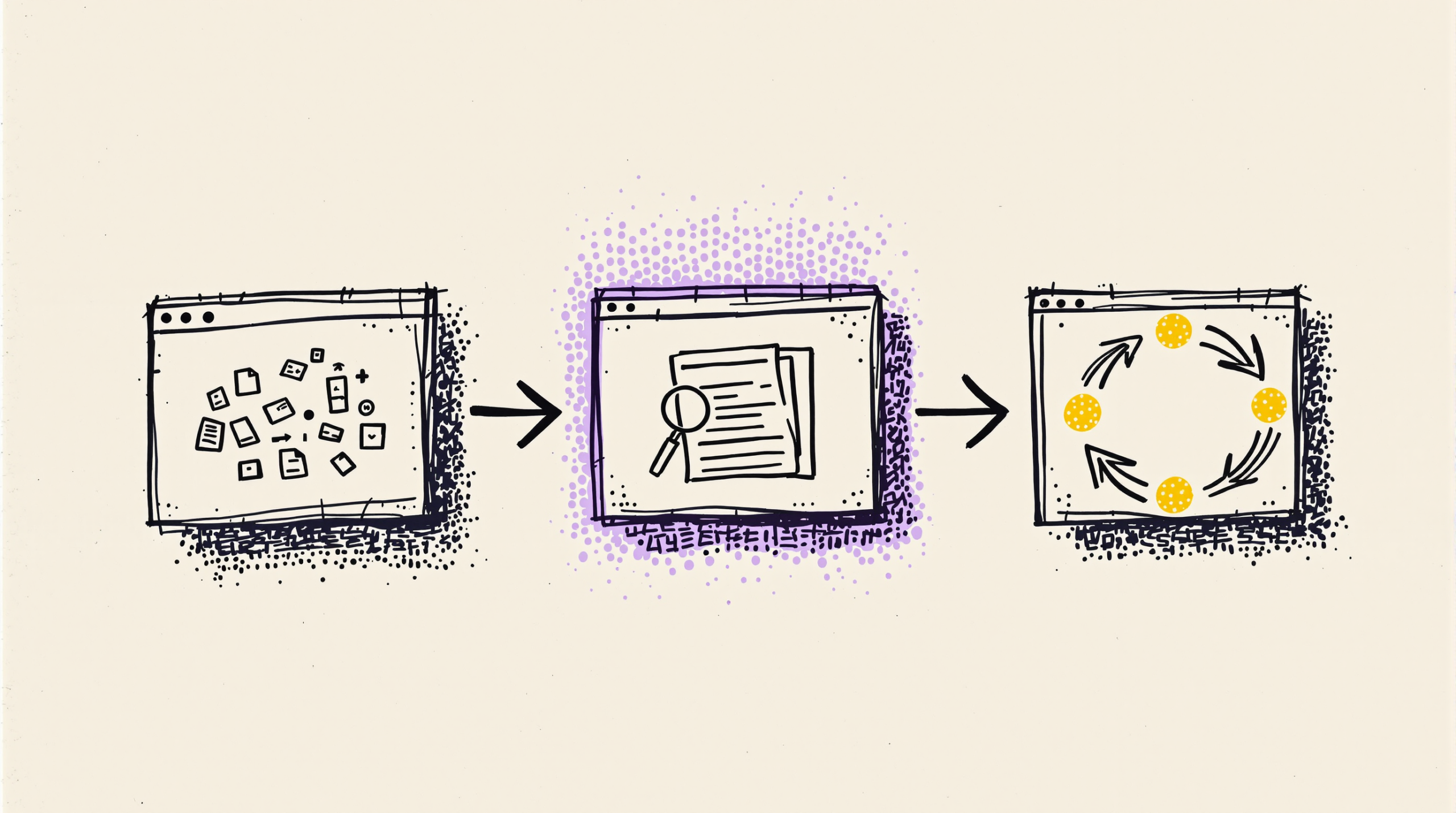
- Audit what exists. Pull every brand-adjacent doc you have: pitch decks, About pages, sales scripts, founder LinkedIn posts, the “About Us” copy on your homepage. The brand is in there. It is just scattered. The first 60% of your context document is extraction, not invention.
- Test against AI immediately. After drafting each section, paste it into Claude or ChatGPT with a real generation task (“Write a 200-word LinkedIn post about [your most recent customer win]”). Compare the output to what your team would actually ship. If the gap is large, the section is missing context. Add it. Re-test. Repeat until the output reads like you, not like a competitor.
- Treat it as living. This document gets updated when the brand learns something new. New objection from a sales call goes into Section 2. New “never say” decision goes into Section 4. Every quarter, audit which sections have not been touched. Those are the parts of your brand that have either gone stale or were never alive in the first place.
Most teams underestimate how much time this takes. Plan for 15 to 20 hours over 3 weeks for a first version. The teams that try to do it in a weekend produce a brand book, not a brand context document.
Common failure modes
Three patterns trip up nearly every team that tries this without help.
The “we have a brand guide” trap. Teams confuse documentation density with documentation usefulness. A 60-page PDF brand bible from an agency in 2022 is less useful to AI than 8 specific paired examples in Section 3. Pages do not equal context.
The over-engineered prompt library. When the architecture (Sections 1 through 6) is missing, teams compensate by writing more and more elaborate prompts. The prompts get longer. The output gets worse. If you find yourself writing a 600-word prompt to produce a 200-word post, your context document has a hole and you are patching it with prompt complexity. Fix the hole instead.
The AI-only architecture. Some teams write the Brand Context Document for AI tools alone. That is a half-decision. The same document should onboard a new contract writer, a new agency, a new junior hire, or a new fractional advisor. If only an AI can use it, you have written documentation for a tool, not for a brand. Brand context documents are AI-friendly because they are clear, not because they are AI-specific.
There is a fourth pattern worth naming: treating this work as a one-time project. Most teams document the brand once, then update it every 18 months. The teams pulling ahead update it monthly, sometimes weekly. The brand is alive. The document should be too.
The bridge to AI activation
This is the part of the argument that matters for everything downstream.
Every AI marketing tool a B2B team will buy in 2026 (content engines, agentic workflows, multi-agent orchestration platforms, AI SDR systems) sits on top of the same input layer. That input layer is the Brand Context Document.
Most B2B AI tools today are typing assistants, not thinking assistants. They produce volume in the voice you give them. If your inputs are vague, your outputs are vague. If your inputs are specific, sharp, and contradiction-free, your outputs feel like an extension of your team.
The architecture comes first. The activation comes second. The order is non-negotiable.
If you want to see what good looks like before you commit to the work, our B2B marketing systems primer walks through the systems layer that sits underneath this document. The document is the strategic asset. The systems make it executable.
Close
The next 12 months will produce a clear separation in B2B marketing.
On one side: teams running AI on brand context that does not exist. Their output will look fine and feel generic. Their pipeline will hold steady or quietly decline.
On the other side: teams that did the unglamorous work of writing down what their brand actually believes, in a format their tools can read. Their output will feel like them. Their pipeline will compound.
The Brand Context Document is not a deliverable. It is the prerequisite to every AI investment B2B is about to make.
Document the brand. Then deploy the tools. The order matters more than the budget.
If you want a structured walk-through of where your brand context lives today and where it is missing, the AI Readiness Audit is the entry point. Three weeks. One document. The rest of your AI roadmap actually works after.