

Customer journey maps are often created in a flurry of workshop excitement, only to gather digital dust in a forgotten folder. The problem isn’t the concept; it’s the execution. Most maps become static documents rather than living strategic tools that align marketing, sales, and service teams to create a frictionless buyer experience. Without a solid foundation in building a user journey map from the start, these efforts are often destined to fall short of their potential.
For Canadian and US B2B companies, getting this right is the difference between stalled growth and a predictable pipeline. In fact, companies that excel at managing the customer journey see a 54% greater return on marketing investment. This guide moves beyond theory, providing 10 detailed, actionable B2B customer journey mapping examples tailored for the technology, manufacturing, and professional services sectors across North America.
We'll break down the stages, personas, pain points, and, most importantly, the specific strategic plays a Fractional CMO would implement to turn these maps into revenue-generating assets. You'll get replicable strategies you can apply immediately to improve lead generation and customer acquisition. If you’re ready to transform your approach, Contact us to build a journey map that converts. to see how we can build a strategy that delivers results.
1. SaaS Free Trial to Paid Conversion Journey
For B2B SaaS companies, the journey from a free trial signup to a paid subscription is the most critical path to measure and optimise. This specific customer journey mapping example focuses on the crucial onboarding and value-realisation period, tracking user behaviour from initial signup through to the conversion decision. It's an indispensable tool for Canadian tech startups and scale-ups where Monthly Recurring Revenue (MRR) growth is paramount.
Companies like Slack excel here by delivering immediate value. Their onboarding guides users to create channels and send their first message within minutes, demonstrating the product's core utility almost instantly. This rapid "time-to-first-value" is a leading indicator of conversion likelihood. In fact, for SaaS businesses, improving customer retention by just 5% can increase profits by 25% to 95%.
Tactical Breakdown
- Key Stages: Awareness, Signup, Onboarding, Feature Adoption, Value Realisation, Conversion Decision.
- Persona Focus: "Sarah," a Product Manager at a mid-sized US tech firm looking for a collaboration tool that integrates with her existing stack.
- Pain Points: Confusing UI, feature overload, lack of clear guidance, and difficulty demonstrating ROI to her manager (the economic buyer).
B2Better Pro-Tip: Map the end-user's journey (Sarah) and the economic buyer’s journey separately. Sarah needs to experience the product's value firsthand, while her manager needs to see a clear business case. Your activation tactics must address both personas.
Optimising this journey directly impacts revenue. By mapping user behaviour with tools like Mixpanel or Amplitude, you can pinpoint friction points. For instance, A/B testing your welcome email sequence or in-app tutorials can lead to significant gains. Even a 5% improvement in trial-to-paid conversion rate can compound into substantial long-term revenue growth, a strategy that has proven highly successful for companies like HubSpot.
Ready to reduce friction in your trial experience? Contact us to build a journey map that converts.
2. B2B Enterprise Sales Cycle with Multiple Decision-Makers
Mapping the journey for a high-value enterprise sale is fundamentally different from a single-user transaction. This customer journey mapping example dissects the long, complex buying process involving multiple stakeholders, from initial research to final negotiation. It is essential for North American industrial firms and tech companies where sales cycles often span 6-18 months and involve a committee of five to ten decision-makers.

Salesforce is a master of this journey, using detailed account maps, ROI workshops, and tailored proof-of-concept phases to align technical, financial, and executive stakeholders. Their success hinges on orchestrating consensus across different departments, a strategy that turns a complex buying process into a clear path to purchase. For a deeper dive into the specific considerations and strategies for these complex pathways, exploring dedicated resources on B2B customer journey mapping can be highly valuable.
Tactical Breakdown
- Key Stages: Problem Identification, Research & Discovery, Stakeholder Consensus, RFP & Vendor Evaluation, Negotiation, Procurement.
- Persona Focus: "David," the VP of IT (technical champion), "Cynthia," the CFO (economic buyer), and "Maria," the procurement manager at a large Canadian company.
- Pain Points: Misaligned priorities between departments, lack of a clear business case for the CFO, navigating internal politics, and complex security/compliance reviews.
B2Better Pro-Tip: Don't just sell; facilitate internal agreement. Create a "Consensus-Building Toolkit" with comparison matrices, ROI calculators, and internal presentation templates that your champion (David) can use to persuade the other stakeholders like Cynthia.
This journey is non-linear and requires immense patience and precision. According to Gartner, 77% of B2B buyers state their latest purchase was very complex or difficult. By mapping each stakeholder's unique motivations and providing tailored enablement materials (e.g., technical architecture docs for IT, business cases for finance), you can significantly shorten the cycle. Using intent data from platforms like 6sense helps identify when a buying committee is forming, allowing you to engage at the perfect moment.
Ready to orchestrate your complex enterprise sales cycle? Contact us to build a journey map that aligns every stakeholder.
3. Manufacturing B2B Lead Generation to Contract Journey
For industrial manufacturing and equipment suppliers in the United States and Canada, the journey from initial inquiry to a signed contract is complex and high-stakes. This customer journey mapping example is tailored for long buying cycles (3-6+ months) involving multiple technical and financial decision-makers. It’s crucial for B2B manufacturing firms aiming to shorten sales cycles and improve lead quality from highly specific audiences like plant managers and procurement directors.
Companies like ABB excel by mapping this journey meticulously. They provide engineers with detailed technical specifications, CAD files, and ROI calculators early on, building trust and embedding their solutions into the planning phase. This approach ensures they become the preferred vendor long before the procurement stage begins. The success of this strategy is clear: B2B companies with superior customer experiences achieve twice the revenue growth of their competitors.
Tactical Breakdown
- Key Stages: Problem Awareness, Research & Discovery, Technical Evaluation, Procurement & Justification, Purchase, Post-Sale Support.
- Persona Focus: "David," a Plant Engineer at a mid-sized processing facility in the US Midwest tasked with sourcing a new robotic automation system to improve line efficiency.
- Pain Points: Difficulty finding comparable technical data, proving ROI to procurement, managing complex implementation requirements, and navigating internal approval processes.
B2Better Pro-Tip: Your content must serve both the technical user (the engineer) and the economic buyer (the CFO/Procurement Director). Provide downloadable spec sheets and CAD files for David, but also create TCO models and case studies quantifying downtime reduction to win over the budget holder.
Mapping this journey reveals critical touchpoints for B2B lead generation strategies. By optimising SEO for technical keywords (e.g., 'robotic arm payload capacity') and creating gated assets like whitepapers, you capture high-intent leads. According to Gartner, B2B buyers complete nearly 60% of their purchase decision before even contacting a sales rep, making robust digital resources non-negotiable.
Ready to shorten your sales cycle? Contact us to map your high-value manufacturing journey.
4. Professional Services Buyer Journey (Consulting, Legal, Accounting)
Unlike a software purchase, the journey for acquiring professional services in North America is driven by trust, expertise, and relationships over a much longer sales cycle. This customer journey mapping example is crucial for firms where the primary product is intellectual capital. It tracks how senior leaders, like CFOs, identify a complex business problem, research potential partners, and make a decision based on credibility and demonstrated results.
Firms like Deloitte and McKinsey have perfected this model. They don't sell services directly; they sell expertise through high-value thought leadership like industry reports and proprietary research. This content intercepts buyers early in their problem-identification stage, establishing the firm as the authoritative expert long before a formal proposal is ever requested.
Tactical Breakdown
- Key Stages: Problem Awareness, Solution Exploration, Firm Evaluation, Proposal & Vetting, Final Selection.
- Persona Focus: "David," a CFO at a Canadian manufacturing company tasked with a digital transformation initiative.
- Pain Points: Identifying the right expertise, verifying past results, overcoming internal resistance to external consultants, and justifying a significant investment with a clear ROI.
B2Better Pro-Tip: The professional services journey is non-linear and built on trust. Your content strategy should focus on consistently providing value through insights, not sales pitches. Map touchpoints across LinkedIn, industry events, and referral networks, as these are often more influential than your website.
Optimising this journey is about building authority and nurturing relationships. According to a study by Hinge Marketing, 81.5% of providers that generate high growth receive referrals from people who have not worked with them directly; they are referred based on reputation and expertise. Publishing detailed case studies with quantified outcomes and positioning firm partners as speakers at key industry events are essential tactics. This approach establishes the credibility needed to win high-value, long-term engagements.
Need to build a client acquisition engine based on expertise? Contact us to map a journey that builds trust and authority.
5. Content Marketing Buyer Journey (Awareness to Brand Advocate)
This customer journey mapping example tracks how a prospect transforms from simply being problem-aware into a vocal brand advocate, fueled entirely by valuable content. It maps the path from initial search discovery through to post-purchase success, focusing on how strategic content guides each step. This journey is essential for B2B marketers in the US and Canada aiming to build long-term trust and authority in their industry.

HubSpot is the quintessential example, using its blog and Academy to educate millions, generating a massive pipeline of marketing-qualified leads. Their 15+ years of content has made them synonymous with inbound marketing, attracting users at every stage of their journey, from initial research to seeking advanced implementation tactics. This strategy pays off: content marketing generates three times as many leads as traditional outbound marketing and costs 62% less.
Tactical Breakdown
- Key Stages: Problem Discovery, Solution Research, Vendor Comparison, Purchase Decision, Implementation Success, Advocacy.
- Persona Focus: "Mark," a Marketing Director at a growing Canadian professional services firm tasked with increasing qualified lead generation.
- Pain Points: Lacks a clear lead generation strategy, unsure which marketing channels to invest in, and needs to prove ROI on his marketing spend.
B2Better Pro-Tip: Your content map must address search intent at every stage. Use keyword research to align topics with what Mark is actively searching for, from "how to generate B2B leads" (awareness) to "best CRM for professional services" (decision).
Optimising this content-driven journey directly builds your sales pipeline. By meticulously mapping content assets to each buying stage, you can identify and fill critical gaps in your funnel. A well-executed content strategy reduces customer acquisition costs and builds a defensible moat of organic traffic, a powerful growth engine for any North American B2B company.
Need to turn your content into a predictable lead-generation machine? Contact us to build a journey map that drives growth.
6. Digital Transformation RFP Journey (Technology Procurement)
For enterprise technology vendors, the journey through a Request for Proposal (RFP) is a high-stakes, structured process that determines multi-million dollar deals. This customer journey mapping example dissects the complex procurement cycle for major systems like ERPs or CRMs. It is particularly vital for Canadian and US firms navigating digital transformation, where procurement teams rely heavily on formal evaluation criteria.
Companies like Salesforce master this journey by aligning their entire sales and marketing engine to the procurement process. They leverage industry-specific case studies, ROI models, and executive-level engagement to build a compelling business case long before the RFP is even issued. This proactive approach ensures they are not just a vendor, but a strategic partner from the outset.
Tactical Breakdown
- Key Stages: Business Case Development, Vendor Shortlisting, RFP Process, Proof of Concept (POC), Reference Calls, Negotiation, Contracting.
- Persona Focus: "David," a Director of IT at a national US logistics company tasked with selecting a new ERP system.
- Pain Points: Lack of internal alignment, unclear success metrics, comparing dissimilar vendor proposals, and managing change management fears.
B2Better Pro-Tip: Your most powerful assets in an RFP journey are third-party validation and social proof. Getting featured in analyst reports like the Gartner Magic Quadrant can get you shortlisted, but strong, quantifiable case studies and glowing reference calls from industry peers are what will get you selected.
Optimising this journey requires a multi-threaded strategy. According to Gartner, 77% of B2B buyers state their latest purchase was very complex or difficult. By providing clear ROI calculators, RFP response templates, and well-defined POC success criteria, you de-risk the decision for the entire buying committee. Winning this journey isn't just about the best technology; it's about providing the clearest, most defensible path to value.
Ready to win more enterprise deals? Contact us to build a journey map that aligns with procurement.
7. B2B E-commerce and Marketplaces Buyer Journey
As B2B procurement increasingly moves online, mapping the self-service buyer journey on e-commerce sites and marketplaces is vital. This customer journey mapping example details the path from product discovery to bulk purchase, focusing on digital touchpoints that replace traditional sales interactions. For distributors and manufacturers across the US and Canada, understanding this journey is key to capturing a growing segment of digitally native buyers.
Platforms like Grainger and Amazon Business have set the standard for this experience. They provide deep product data, real-time inventory visibility, and streamlined checkout processes that mirror B2C expectations but are tailored for B2B needs. Their success demonstrates the immense value in making complex B2B purchasing as frictionless as possible, with the B2B e-commerce market projected to exceed $20.9 trillion globally by 2027.
Tactical Breakdown
- Key Stages: Product Discovery (Marketplace SEO), Specification Review, Supplier Comparison, Quote Request/Negotiation, Checkout & Fulfilment, Re-order.
- Persona Focus: "David," a Procurement Manager for a small US-based manufacturing firm tasked with sourcing components efficiently and within budget.
- Pain Points: Inaccurate product data, poor site search functionality, unclear bulk pricing, slow quote responses, and complicated re-ordering processes.
B2Better Pro-Tip: Your product data is your best salesperson on a B2B marketplace. Invest heavily in high-quality images, detailed spec sheets, certifications, and application videos. This richness of information builds trust and directly accelerates the purchasing decision without human intervention.
Optimising this journey directly impacts sales velocity and customer retention. By focusing on marketplace SEO and providing transparent pricing, you reduce friction and attract qualified buyers. For example, suppliers on Alibaba who actively manage their response rates and customer reviews can see a significant increase in inquiries and orders. A seamless re-order function alone can boost lifetime value by making repeat purchases effortless.
Need to capture more online B2B buyers? Contact us to build a journey map that drives e-commerce growth.
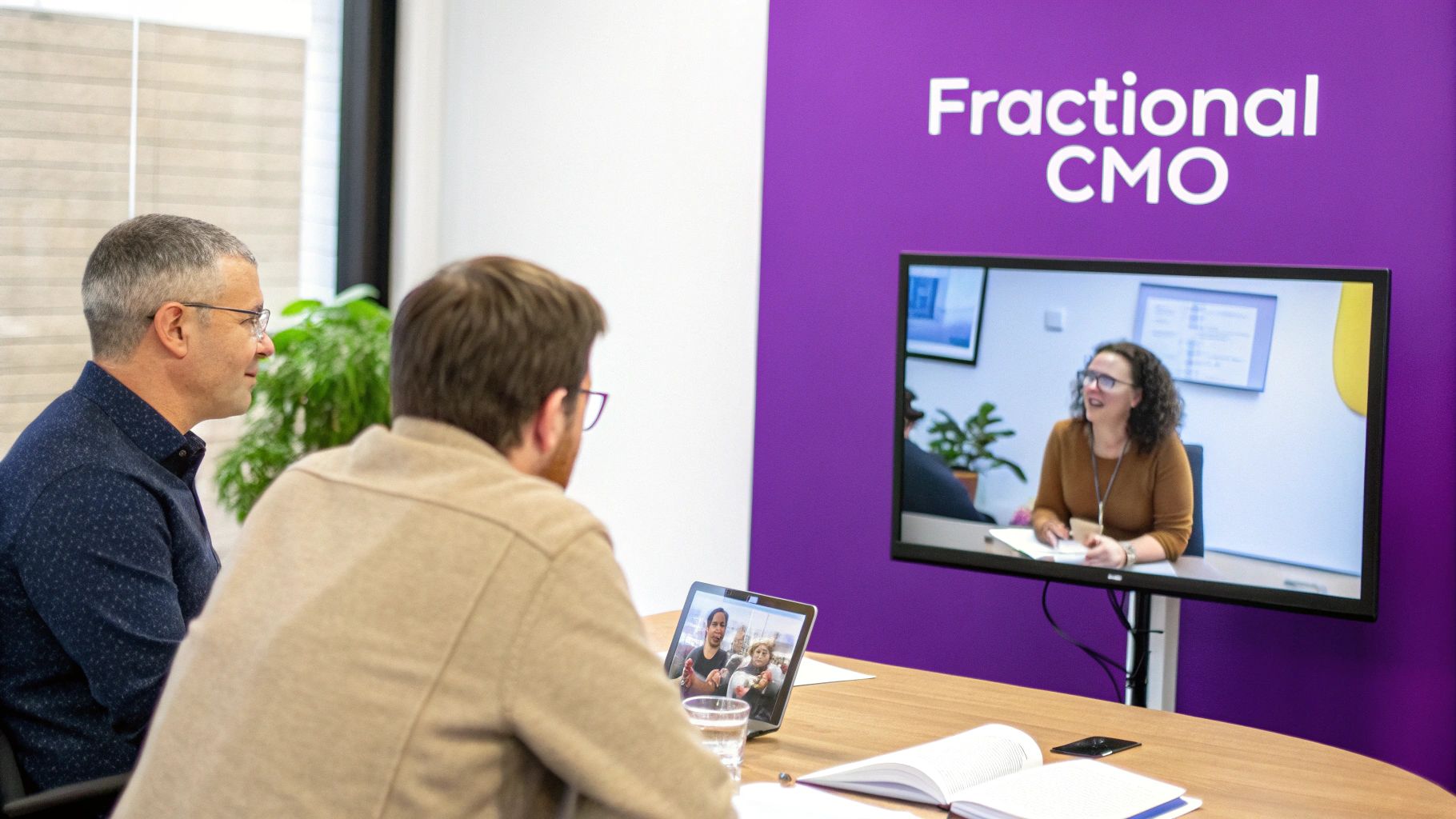
8. Fractional/Outsourced Service Buyer Journey (Consultant/Agency Selection)
For businesses needing specialized expertise without the full-time overhead, the journey to select a fractional executive or agency is fast-paced and trust-driven. This customer journey mapping example is critical for service providers in Canada and the US, like consultants or fractional CMOs, as it outlines a buyer's rapid evaluation process. This journey is often triggered by an immediate strategic gap, such as a need for a new growth plan or a lack of senior marketing leadership, and typically condenses into a 2-4 week decision cycle.
Consulting boutiques and marketplaces like Toptal have mastered this by building credibility through expert content and transparent case studies. They focus on quickly demonstrating value and aligning their specialized skills with the client's urgent business problem, making the selection process efficient and clear for decision-makers under pressure.
Tactical Breakdown
- Key Stages: Problem Recognition, Provider Discovery, Credibility Evaluation, Scoping Call, Proposal Review, Selection & Onboarding.
- Persona Focus: "David," the CEO of a Canadian B2B scale-up who lacks a senior marketing leader to guide his next growth phase.
- Pain Points: Uncertainty about ROI, fear of a poor fit, difficulty comparing providers, and the need for a quick, seamless integration with his existing team.
B2Better Pro-Tip: Speed and social proof are your most valuable assets. Respond to inquiries within hours, not days. Showcase detailed case studies with before-and-after metrics on your website and LinkedIn profile. A referral from a trusted peer often short-circuits the entire discovery and evaluation process.
Optimising this journey hinges on building authority and reducing friction. Developing specific content that addresses common client concerns, such as the onboarding process or measuring success, can pre-emptively answer David’s questions. Firms that publish detailed client results often see a significantly shorter sales cycle. For service providers, mapping and refining this path is essential for client acquisition. Explore our fractional CMO services to see how this model delivers strategic value.
Need to attract high-value clients? Contact us to map a journey that builds trust and wins business.
9. Inbound Marketing and Content-Driven Customer Acquisition Journey
This customer journey mapping example tracks how prospects discover, engage with, and are nurtured by content, rather than direct sales outreach. It focuses on building trust and authority by providing value upfront, guiding buyers through a self-directed discovery process. For B2B firms across Canada and the US, this inbound-first approach is the engine for scalable, high-quality lead generation.
HubSpot famously built its empire on this model, attracting its target audience with blogs, guides, and free tools. This content-driven journey allowed them to educate the market and generate over 100,000 customers, proving the model's immense power. Research shows that 70% of B2B buyers consume blog content during their purchasing journey, underscoring its critical role.
Tactical Breakdown
- Key Stages: Awareness (SEO, Social), Consideration (Webinars, Case Studies), Decision (Demos, Consultations), Retention (Customer-only Content).
- Persona Focus: "Mark," a Marketing Director at a mid-sized American manufacturing firm researching marketing automation solutions.
- Pain Points: Lacks expertise in a new area, overwhelmed by solution options, needs to build a business case with clear ROI, and distrusts traditional sales pitches.
B2Better Pro-Tip: Your content must map directly to buyer pain points at each stage. An awareness-stage blog post about "improving lead quality" should lead to a consideration-stage guide on "choosing a marketing automation platform." Guide the journey, don't just create content.
Mapping this journey is fundamental to understanding content ROI. By tracking which assets (e.g., a whitepaper or ROI calculator) influence pipeline, you can double down on what works. This is how you transition from just creating content to building a predictable revenue machine. Understanding the foundational principles of what inbound marketing is can supercharge these efforts.
Ready to turn your content into a predictable lead-generation engine? Contact us to build a journey map that converts.
10. Account-Based Marketing (ABM) Buyer Journey for High-Value Prospects
For B2B organisations pursuing enterprise deals in North America, the traditional marketing funnel is often too broad. An Account-Based Marketing (ABM) buyer journey flips the model, focusing intense, personalised marketing and sales efforts on a select few high-value target accounts. This customer journey mapping example is less about volume and more about surgical precision, aligning teams to create a bespoke experience for the entire buying committee.
Companies like Terminus and 6sense have pioneered this approach. They use intent data to identify in-market accounts and then orchestrate multi-channel, personalised campaigns that speak directly to the specific challenges and roles within that organisation. This coordinated effort can increase deal sizes by over 170%, making it a powerful strategy for enterprise sales.
Tactical Breakdown
- Key Stages: Account Identification, Research & Insight, Personalised Outreach, Nurturing the Buying Committee, Sales Engagement, Proposal & Negotiation.
- Persona Focus: "David," the CFO of a target enterprise account in the US, and "Maria," the Director of Operations who will be the end-user champion.
- Pain Points: Generic messaging, lack of understanding of their specific industry challenges, uncoordinated outreach from sales and marketing, and content that doesn't address financial ROI.
B2Better Pro-Tip: Your ABM journey map must account for the entire buying committee. Map the touchpoints for the champion (Maria), the economic buyer (David), and the technical influencer. Each requires different content and messaging to build consensus toward a purchase decision.
Optimising an ABM journey is about quality, not quantity. By meticulously mapping out a hyper-personalised path with tools like HubSpot or Marketo, you can engage key stakeholders with the right message at the right time. For example, a targeted LinkedIn ad campaign for the C-suite combined with a value-driven webinar for the operations team ensures a consistent and relevant experience, dramatically improving the odds of closing a complex, high-value deal.
Ready to land your dream clients with a precision ABM strategy? Contact us to build a journey map that closes enterprise deals.
Comparison of 10 Customer Journey Mapping Examples
| Journey | Implementation complexity | Resource requirements | Expected outcomes | Ideal use cases | Key advantages |
|---|---|---|---|---|---|
| SaaS Free Trial to Paid Conversion Journey | Medium–High: product analytics and onboarding flow design | Product analytics (Amplitude/Mixpanel), UX, customer success, email automation | Improved trial-to-paid conversion, lower early churn, increased MRR | B2B SaaS startups and scale-ups offering trials/freemium | Direct revenue correlation; actionable behavioral triggers; measurable optimization |
| B2B Enterprise Sales Cycle with Multiple Decision-Makers | High: multi-stakeholder mapping and lengthy coordination | CRM, sales enablement, tailored content, executive sponsorship, ABM tooling | Larger ACV, long sales cycles, complex attribution | Enterprise software, industrial buyers, large professional services deals | Stakeholder-specific content; higher win rates on complex deals; strategic differentiation |
| Manufacturing B2B Lead Generation to Contract Journey | Medium: technical content plus trade-show coordination | Technical spec sheets, CAD files, trade shows, engineering sales support | Higher lead quality, specification-driven shortlisted deals, repeat purchases | Industrial equipment suppliers, manufacturers targeting plant engineers/procurement | Specification credibility; trade-show ROI; strong technical trust-building |
| Professional Services Buyer Journey (Consulting, Legal, Accounting) | Medium: reputation and relationship management | Thought leadership, case studies, speaking engagements, referral networks | High-value engagements, strong referrals, premium pricing | Consulting, law, accounting and advisory firms | Reputation-driven acquisition; high margins; relationship and credibility focus |
| Content Marketing Buyer Journey (Awareness to Brand Advocate) | Medium: ongoing editorial strategy and SEO discipline | Content creators, SEO, distribution, analytics, content ops | Sustainable organic traffic, scalable lead gen, long-term pipeline growth | Organizations investing in inbound and education-led sales motions | Compounding organic ROI; trust-building; scalable lead generation |
| Digital Transformation RFP Journey (Technology Procurement) | High: structured RFPs, POCs, and analyst relations | RFP response teams, implementation partners, case studies, analyst coverage | High-value contracts, long procurement timelines, strong referenceability | ERP/CRM/HCM vendors and mid-market digital transformation projects | Predictable procurement touchpoints; multiple engagement opportunities; risk-reduction via references |
| B2B E-commerce and Marketplaces Buyer Journey | Low–Medium: catalog ops and marketplace management | Product data management, listings, logistics, pricing, reviews management | Faster transactions, higher order volume, lower per-order ACV | Manufacturers, distributors, suppliers using marketplaces or direct e-commerce | Self-service scale; rich behavioral data; repeat purchase automation |
| Fractional/Outsourced Service Buyer Journey (Consultant/Agency Selection) | Low–Medium: rapid evaluation and credibility signals | Case studies, consultant directories, LinkedIn presence, fast proposal process | Quick conversions, project revenue, opportunity to convert to retainers | Fractional CMOs, consultants, agencies offering short-term engagements | Short sales cycles; strong referral influence; flexible engagement models |
| Inbound Marketing and Content-Driven Customer Acquisition Journey | Medium: content program plus martech integration | Content team, SEO, marketing automation, analytics, landing pages | Predictable lead pipeline, lower CPL over time, slower time-to-ROI initially | B2B firms prioritizing organic growth and education-led acquisition | Compounding content value; educated leads; reduced reliance on paid channels |
| Account-Based Marketing (ABM) Buyer Journey for High-Value Prospects | High: heavy personalization and cross-team coordination | ABM platforms, account research, bespoke content, close sales-marketing alignment | Higher conversion for target accounts, larger deal sizes, concentrated pipeline | Sellers pursuing strategic, high-ACV enterprise accounts | Highly personalized engagement; improved win rates; increased deal size |
From Map to Momentum: Activating Your Customer Journey
We have journeyed through a diverse landscape of B2B customer journey mapping examples, from the nuanced stages of a SaaS free trial conversion to the complex, multi-stakeholder enterprise sales cycle. Each map, whether for manufacturing, professional services, or a high-value ABM campaign, tells a unique story of a customer’s path to purchase. Yet, they all share a common, powerful truth: a customer journey map is not a static document. It is a dynamic blueprint for growth.
The real value emerges when you move from mapping to execution. These detailed examples demonstrate that success isn't just about identifying touchpoints and pain points; it’s about strategically intervening at those moments with the right content, activation tactics, and personalized experiences. The goal is to transform friction into flow, doubt into decision, and customers into dedicated advocates.
Key Takeaways from Our B2B Journey Map Exploration
As you prepare to build or refine your own maps, remember these core principles distilled from the examples:
- Persona is Paramount: A map without a clearly defined buyer persona is a map without a destination. The specific needs, goals, and pain points of your ideal customer in Canada or the US must inform every stage and touchpoint.
- Data Drives Direction: Assumptions can be costly. Ground your map in both qualitative data (customer interviews, sales team feedback) and quantitative data (website analytics, CRM data, support tickets) to reflect reality. According to a Salesforce report, 84% of customers say the experience a company provides is as important as its products and services.
- Friction is Your Focal Point: The most significant opportunities for improvement lie within your customer’s biggest frustrations. Prioritise solving these pain points to deliver immediate value and build trust.
- Activation is Everything: A map is only a tool. Its power is unlocked through targeted action, whether that’s creating a new case study, optimising an onboarding email sequence, or training your sales team on a newly identified customer objection.
Your Next Steps: Building a Better Growth Engine
Armed with these customer journey mapping examples, you are now equipped to look at your own business with a fresh perspective. The first step is to choose one specific journey to map. Don’t try to boil the ocean; start with a high-value segment, like the enterprise sales cycle or a key inbound marketing funnel.
Once your initial map is drafted, the real work begins. The challenge often lies in prioritising initiatives and allocating resources effectively. Do you focus on top-of-funnel content to address awareness-stage pain points, or do you double down on a smoother onboarding experience to improve retention? Answering these questions correctly is the difference between incremental gains and transformative growth.
This strategic prioritization is precisely where an experienced hand can guide you. Understanding how to interpret the map and translate its insights into a cohesive, revenue-focused marketing plan is critical for B2B organizations across Canada and the United States. It ensures that every action you take is a deliberate step toward a more predictable and profitable customer acquisition process.
Turning these customer journey mapping examples into a real-world growth strategy requires both insight and execution. B2Better provides the Fractional CMO leadership to help B2B tech and industrial companies bridge that gap, prioritising the actions that drive measurable results. If you’re ready to activate your customer journey and build a powerful growth engine, contact us today.